Overlooked and undervalued potential of Slovakian brownfield
Colliers International, one of the leading international real estate companies, drew the attention to the continually overlooked potential of brownfields in Slovakia in its recent report. When the foreign investors arrive to our country, their focus is not exclusively on construction of new plants on greenfields, they also look at former or stagnating production complexes. And it is these that offer several underestimated advantages: a higher level of built-up area, infrastructure and a less complicated process of obtaining planning permissions, which significantly reduce the expenditure necessary for “clearing the target area“.
“Currently we are witnessing setbacks of many city industrial parks projects which did not manage to attract tenants to their space. Often these were greenfield projects,“ emphasises Martin Varačka, head of the industrial real estate department at Colliers International.
Former halls after reconstruction
What do Colliers International clients‘ experiences indicate? “Investors wishing to operate an enterprise look mainly for such spaces which offer a certain comparative advantage,“ reasons the report and this is illustrated by examples on good transport connections or the average wages in a given region. There are even projects that know how to successfully stand out but which are not located next to a highway.
 The former Tatra complex in Bánovce nad Bebravou or
the planned Industrial park Gemer in Rimavská Sobota are a proof, according
Colliers, that former thoroughly reconstructed production halls can adquately
satisfy the requirements of manufacturers from the automobile, electronics or
machinery industries, but also of the manufacturers of building materials.
The former Tatra complex in Bánovce nad Bebravou or
the planned Industrial park Gemer in Rimavská Sobota are a proof, according
Colliers, that former thoroughly reconstructed production halls can adquately
satisfy the requirements of manufacturers from the automobile, electronics or
machinery industries, but also of the manufacturers of building materials.
As was mentioned even at the recent discussion meeting Industrial parks in the east: successful and problematic solutions, there are four brownfield locations on the area of the city of Košice alone, on offer for a new investment usage: Slovenské magnezitové závody, river Hornád – housing estate Nad jazerom, village Krásna nad Hornádom – adjoining the housing estate Nad Jazerom – channel of the Hornád river and the extensive complex of former VSŽ not far from the city suburb of Šaca. In Jaklovce, four production halls in the former complex of Prefa have been renovated, three originally German “limited companies“ focused on electronics and energy industry, have already managed to be drawn here. The situation is similar in the case of industrial park in Kojšov (three production halls formerly serving as a timber mill), brownfield, where two investors settled down.
Symbiosis of production and new functions
The general definition and categorisation of brownfields is noted for its heterogeneity. As in every area, the problems of brown zones are rooted in the specific political, institutional, strategic, legislative and legal framework. Its standing in area-planning and analytical records is equally important, as is the project scope for a complex change solution in a specific area.
The factors limiting the conversion of brownfields and determining the subsequent redevopment of a given location have to considered thoroughly and evaluated even in the pre-planning phase of a project. Factors include the question of rehabilition of damaged environment, project risks during restoration of an area burdened by long term production, possibilities of involving the private development sector, usage of eurofunds, or in case of need financing via PPP projects or in co-operation with Slovak Investment and Trade Development Agency (SARIO). No less useful is the knowledge of specific examples of successful solutions of brownfields abroad (Prague, Ostrava, Warsaw, Krakow, Linz).
The transformation and development of the decomissioned production zones in the complexes of former or still functioning factories involve revision of functions of individual industrial units and their subsequent change to a different production programme from the original. The brown zones suitable for conversion may, however, be also obsolete or unused logistical complexes which reach a considerable number across the whole of Slovakia.
The new owners who acquired the complexes through privatisation, have the opportunities to sell or lease part of the real estate property – buildings and land – for a completely new, non-production usage. This can be artists‘ studios, galleries, green areas, administrative, housing, schooling, trading, sporting, cultural, social, leisure and other facilities. Moderm prospects of a symbiosis of purely production essence with other functions are being sketched out.
Convergence of industrial and urban structure
 The fundamental aims for solving the problems of
brownfields pursue above all the increase in the crediworthiness of the land,
modernisation, broadening and improving the attractiveness of the areas and
spaces for carrying out new enteprise activities, professional removal of old
environmental burden, improvement of ecological parametres of the environment,
and, not the in the least, a lasting and sustainable development of the
society.
The fundamental aims for solving the problems of
brownfields pursue above all the increase in the crediworthiness of the land,
modernisation, broadening and improving the attractiveness of the areas and
spaces for carrying out new enteprise activities, professional removal of old
environmental burden, improvement of ecological parametres of the environment,
and, not the in the least, a lasting and sustainable development of the
society.
Possibilities of mutual convergence of the production establishment with the organism of the town, and therefore the eliminating the antagonism between its industrial and urban structure, may be diverse and defined by not only local specifics but also its location alone: either in the heart (Cassovar Košice), within a direct touch (Slovnaft Bratislava) or beyond the boundaries of the urban area (US-Steel Košice). The current trend is consisely characterised by the topical ideological slogan: “Production zones are opening themselves to the town – the town is entering the production zones“.
The sequence of the steps in the revitalisation process and renewed use of brownfields:
- Definition of the new purpose of the unused area
- Planning of the realisation of its transformation and subsequent use
- Feasibility study on return on investment of the project
- Securing financing from several sources
- Construction and technical preparation of the area for the new use
Illustrations – Global Group
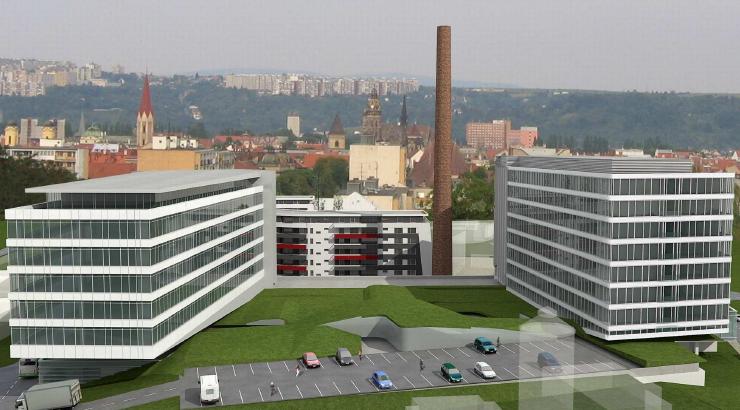
1, 2 – Conversion of the brown zone of the former brewery into a
multifunctional complex Cassovar in the geometric city centre of Košice is a
splendid example of interconnection of old and new architecture
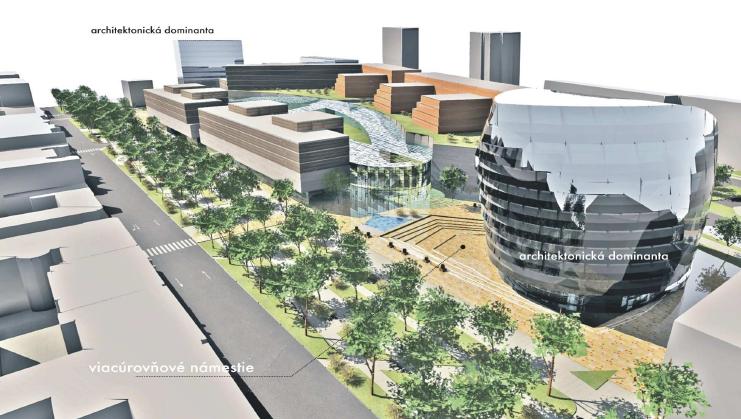
3 – Tender proposal for the transformation of Malinovského kasárne
(Košice)