

EUBE: regional development mission
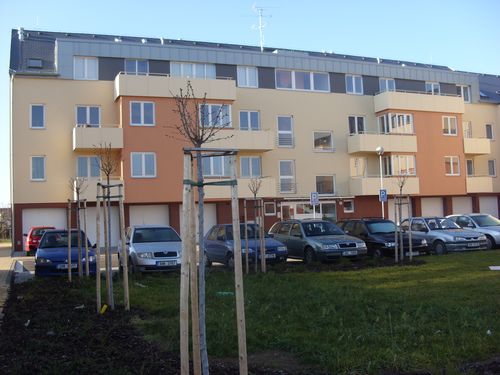
At the time of its erection in the 1980s, the Latin-sounding name Terronic was given to a strange, almost post-functionalistic building constructed at the periphery of Hradec Králové in an effort to breathe fresh air to the then dwindling Czechoslovak electrical engineering industry. This building was and remains a dominant landmark for the city, and therefore the development company Eube used the name to call a residential complex it started building here about five years ago. The 5th stage of this project is just starting on this “new” Terronic.
Eube was founded in 1997, at a time when most domestic developers focused almost exclusively on Prague, where demand for all types of commercial properties and flats could be expected because of the city’s exceptional economic potential and other factors. At the end of 1990s, however residential properties and their construction started appearing outside the capital as well. The reason was simple: the need for housing exists everywhere, which cannot be said about type A offices and gigantic logistics complexes. Of course, residential projects are still cropping up mainly in Prague today, with its easily strongest effective demand in the whole Czech Republic, but the large potential of housing construction in other regions is exploited to a larger degree. Eube is a pioneer in this respect and still one of the few domestic developers oriented at individual regions, but not with a local reach. “We have undertaken projects in the whole Czech Republic – in Hradec Králové, Pardubice, where we premiered in development in 1999, in Poděbrady, Karlovy Vary and many other cities, including smaller ones – Cheb, or today also Lanškroun and Jablonec,” says Allan Jírek, the company’s director.
It is obvious that the Hradec Králové region is the primary target of Eube’s plans. The company started its business in this region and has been active there until today. “At the beginning of this millennium Hradec Králové had a huge deficit of new flats. And the city, in an effort to reach the 100,000 population mark, launched a housing construction support program. High demand in combination with this support made it an ideal place for residential projects,” says Jírek. According to him, however, the regional economic and social climate has other advantages for the developers, too.
Regional bonuses
Regions outside the capital generally have a lower price level. “There is a principal difference in the costs of acquisition of land. While in Prague projects, the prices of land are even in the tens of thousands of Czech crowns per square metre, we purchased our most expensive land in Hradec Králové for CZK 2,400 per metre,” says Jírek. That is why the purchase of land plays a much smaller role in the price calculations than in the capital. Yet this is not the only saving on investment costs. “In the regions we build about 20 to 25% cheaper than in Prague,” Dalibor Šubrt, director of Eube’s Hradec Králové branch, emphasizes another advantage of the “hinterland,” adding: “We rely on local resources also in architecture; the Šuda a Horský design office is our key supplier in this area. Likewise, we rather seek local building companies.” According to Šubrt, in this way it is possible to reduce costs as well as to establish useful long-term contacts, thus ensuring the needed support for the company and its projects among the public (including potential customers) and the authorities. Another material benefit is competition, which is undoubtedly weaker, but is likely to grow stronger in the regions in the near future. But Eube’s director also mentions the economic dark side of regional development: “Of course, selling prices and total revenues are lower than in Prague because of the different market conditions.” And there are certainly more drawbacks for regional projects.
Crisis is everywhere
“We‘re experiencing a period of crisis in consumer confidence,” says Allan Jírek, who can also see some positives, aside from the negative impacts of the ongoing economic recession. “The crisis educates developers – especially to apply stronger financial management. No wonder the first cost-saving measures taken by development firms were aiming at their own overhead costs.” Even more so because, according to Jírek, developers do not have much leverage to support the dwindling demand (the slowing sales are troubling for the amortization of bank loans) by cutting prices. “Margins of 20 to 30% – that sounds so good and some developers can still generate such results today. But it is necessary to bear in mind that this is not annual profit; everything has to be translated to the whole time of project implementation and, in particular, if you don’t sell all flats, which is not unusual today, the figures become completely different,” Jírek explains the pitfalls of today’s development economy. According to him, the regions cannot avoid such problems, even though they may appear promising from any of the aforementioned points of view. ”As regards the short-term future of several months, I can see some room for continued housing projects in several former regional capitals. When the financial crisis is over and clients’ confidence in banks is restored, a huge space will open up in smaller towns as well, where the construction of new flats is launched very sporadically today.” The director of Eube’s Hradec Králové branch is even more cautious about his city: “About two thousand flats are about to be built in Hradec Králové and its vicinity. And up to 800 flats are planned, among others, in the former Hůrka barracks in the nearby Pardubice. I’m afraid the absorption capacity of the local demand is not so high.”
New opportunities
Jírek can see a certain new room for development, though economically limited, in cooperation with the self-government. “There appear to be certain possibilities in the construction of senior homes, low-cost houses and parking facilities. However, the economy of these projects cannot do without cooperation with the self-government, especially in smaller towns.” This may offer certain opportunities how to offset the current investment crisis in the private sector. According to some data, cities will have a lot of money for construction in the following years, compared to the past.
In spite of all the drawbacks that domestic development faces at present, Eube continues in its regional mission. The 4th stage of the Terronic project is being finished right now, so the roughly 130 finished housing units will be supplemented with another 136 flats next year, of which 40% already have their owners. At the same time, the 5th stage will kick off. “We have purchased the land and have a valid zoning decision. We could start building in the second quarter of 2009,” Dalibor Šubrt comments on the project development. Eube is currently working on other projects in Hradec Králové, too: the Hradecký dvůr apartment house with 150 flats and a parking house in its neighbourhood. In this case the location (it is in the broader centre, close to the train station and the Černigov Hotel) and the design hint at a higher quality – one square metre is sold for CZK 35,000 on average, while in the Terronic project one square metre costs CZK 29,000.
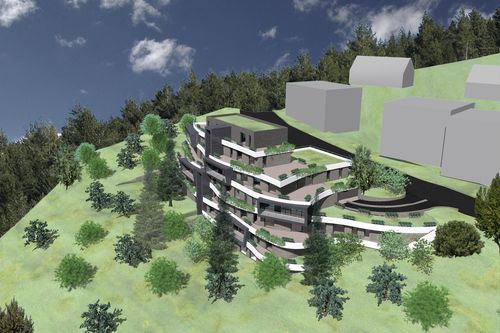
However, even regionally-oriented developer has to think about financial certainty. “In last year’s fourth quarter, our sales of flats dropped significantly,” Jírek points out that the demand in the regions is already starting to go down in spite of the mediocre supply. That is why Eube is preparing several Prague projects – for instance in Prague 4, 5, 6 and 7. The first Prague project will start at the beginning of 2010.
Photographs:
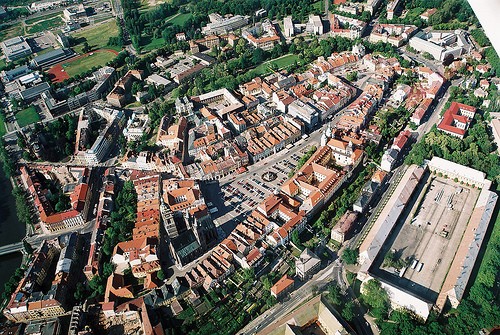
1. Hradec Králové
2. Terronic is one of the biggest residential projects in Hradec Králové.
3. One of the residential projects that EUBE intends to build in Prague.
 Jagg.cz
 Linkuj.cz
 Google Bookmarks
 Live bookmarks
 Digg
Digg Del.icio.us
 MySpace
 Facebook